Almost half of Copilot’s citations on a payments query go to one Websem page.
The “Card payments and bank APIs for ecommerce” study from Benchmark AI, in the AI Performance report in Bing Webmaster Tools: 836 citations and a Citation Share of 48.32% on the grounding query “payment providers local acquiring Romania”, over about eight weeks.
48.32%
Citation Share on “payment providers local acquiring Romania”, in Microsoft Copilot and partners
836
citations of the page on that query, over about eight weeks (daily peak: 37, on 3 September 2026)
31.40%
Citation Share on a close wording, “payment providers with local acquiring Romania”, with 27 citations
 websem.ro Page analysedCard payments and bank APIs (in Romanian) →Data sourceBing Webmaster Tools · AI Performance (beta)Definition of the shareBing Webmaster Blog, 16 June 2026 Screenshots15 October 2026
What share of Microsoft Copilot’s citations on a payments query go to our benchmark page?
On the grounding query “payment providers local acquiring Romania”, the AI Performance report shows 836 citations of the page and a Citation Share of 48.32%: almost half of the citations shown for that query, across all sites.
The share is calculated by Bing, not by us. Microsoft defines it as the percentage of citations attributed to the site out of all citations shown across all sites for the same grounding query.
It is a share of citations, not of answers, and it concerns a single phrase: on a close wording the share is 31.40%. The report has no visits or quote requests.
What we read, and how
- 01
The report
AI Performance in Bing Webmaster Tools, for websem.ro, with the citation source “Microsoft Copilots and Partners” and the 3 M range.
- 02
The table
The “Grounding Queries” tab: the grounding queries, the intent and topic Bing assigns, the citation count and Citation Share. The table has three rows.
- 03
The detail
We filtered on the first query and read the daily chart and the page list, in two captures, with the cursor on 3 September and on 3 October. Daily values other than those in the indicators are read off the chart, so approximate.
- 04
What is not in the captures
The unfiltered page list, competing sites, other periods and other sites’ data. The report does not show them.
What the report shows
01 · Citation Share
48.32%
Almost half of the citations shown for this query are the site’s
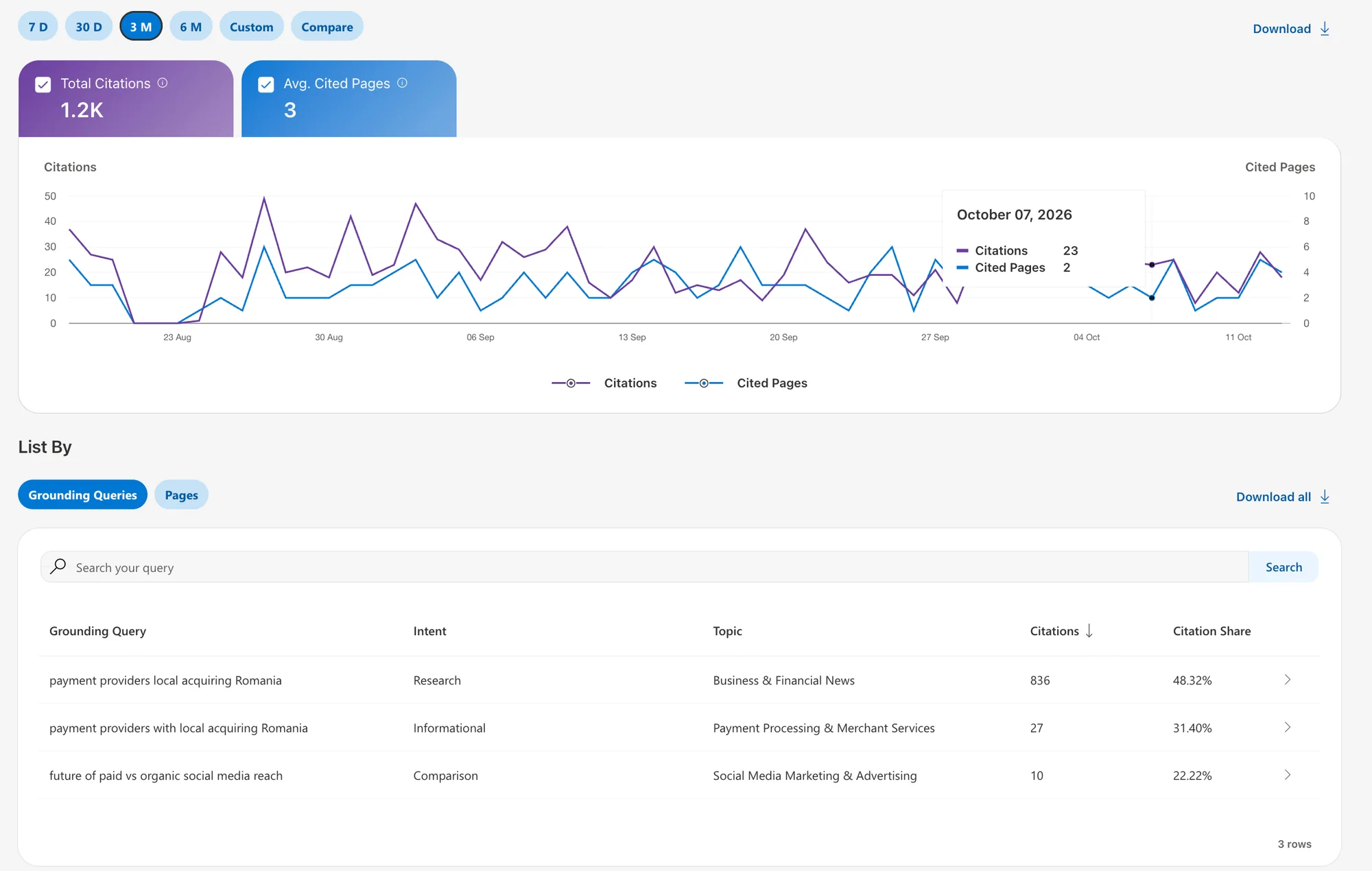
In the “Grounding Queries” tab, the first row is “payment providers local acquiring Romania”: 836 citations and a Citation Share of 48.32%. Microsoft defines the share as the percentage of citations attributed to the site out of all citations shown across all sites for the same query. From the formula it follows, as our own arithmetic, that about 1,730 citations were shown in total for that query, 836 of them websem.ro’s.
What the capture shows
The share comes from the report, not from a calculation of ours: the platform itself shows the site at almost half of that query’s citations.
What it does not show
It does not show that Copilot cites us in half of its answers: the share counts citations, and one answer can show several sources. Nor is it a ranking or a traffic share; Microsoft states the metric is observational and that the report does not show competitor domains.
Fig. 1Bing Webmaster Tools · AI Performance
02 · The queries in the table
836 / 873
Almost all the citations in the table come to a single phrase
The table has three rows: 836 citations on “payment providers local acquiring Romania” (intent Research, topic “Business & Financial News” according to Bing), 27 on “payment providers with local acquiring Romania” (31.40%) and 10 on “future of paid vs organic social media reach” (22.22%), a phrase unrelated to payments. The three rows add up to 873 citations, against about 1.2K in Total Citations; the report does not explain the difference.
What the capture shows
The two queries about card acceptance in Romania add up to 863 citations, with a share of 48.32% and 31.40%.
What it does not show
It does not show which pages receive the 27 and 10 citations, nor where the citations in Total Citations that are not in the table come from. Intent and topic are labels Bing assigns, not ours.
03 · Citations over time
37
Citations across most of the period, peaking at 37 in a day
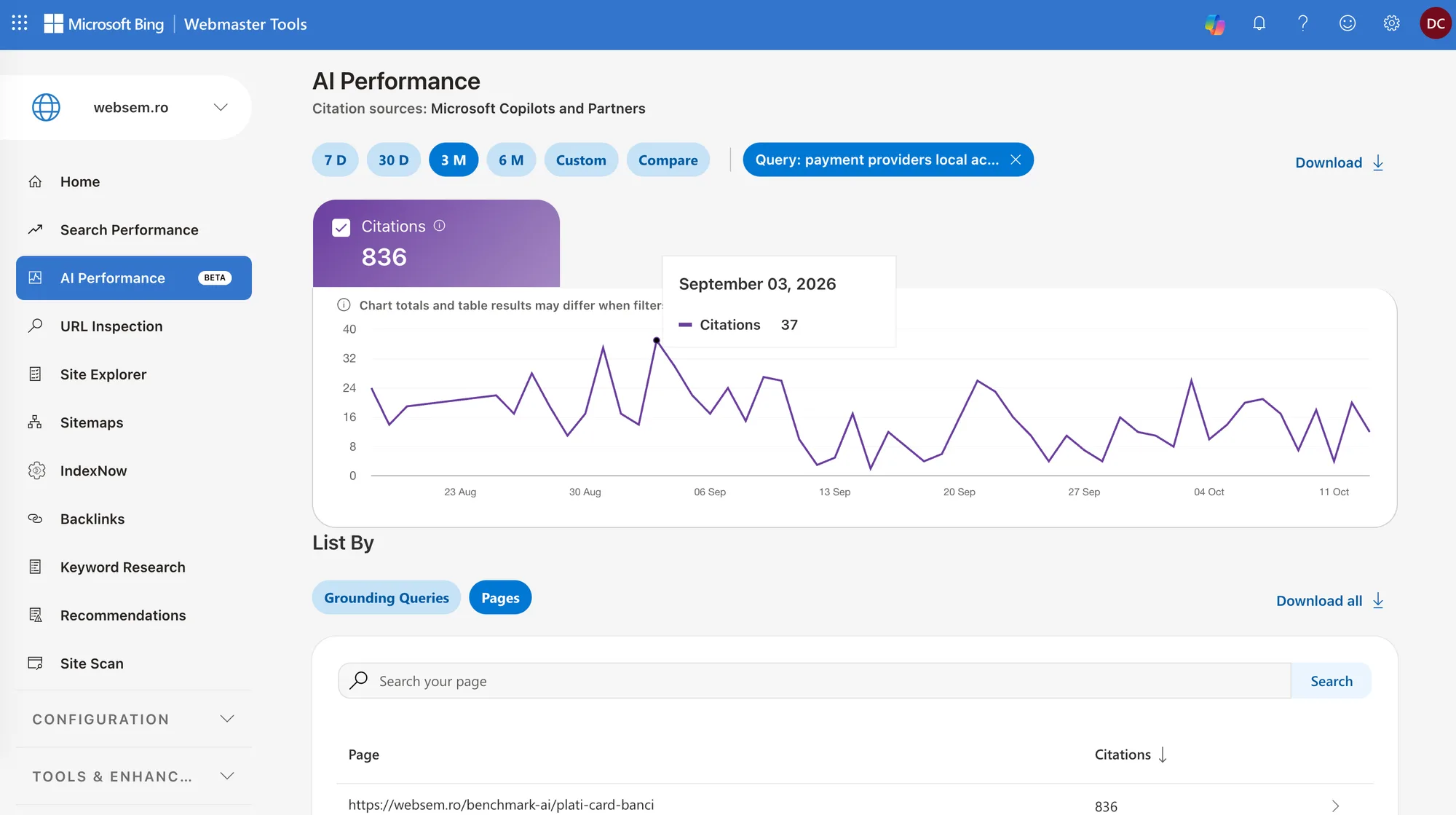
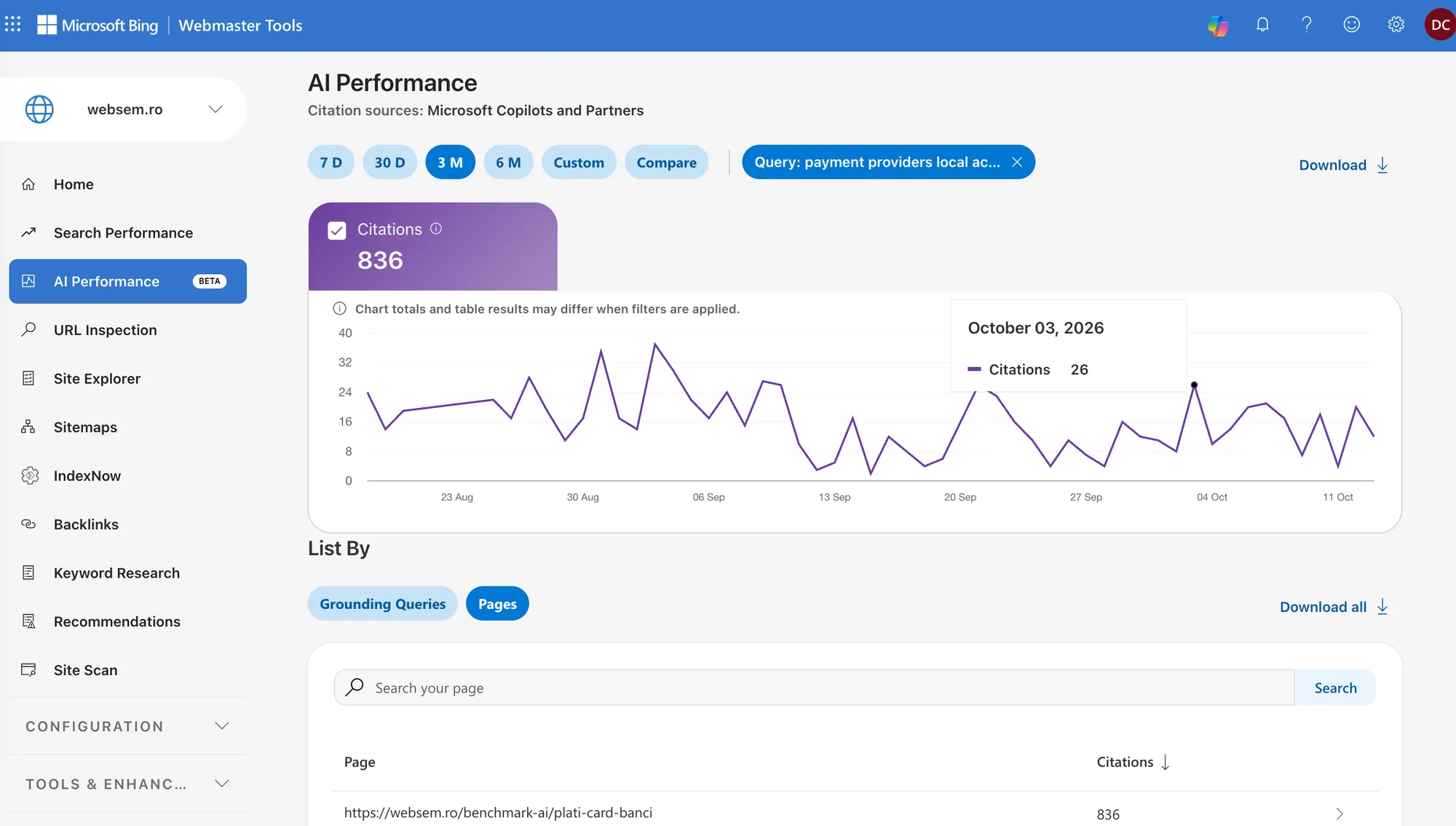
With the filter on the first query, the daily chart climbs to 37 citations on 3 September 2026 and to 26 on 3 October 2026; on days with citations, the weakest values are around 2–4. Between about 20 and 25 August the filtered chart has no points, and the straight line across that interval does not represent daily citations; in the unfiltered report, the site has zero citations around 21–23 August.
What the capture shows
Citations recur across most of the period: the series shows a sustained level, with large daily swings, not an isolated appearance.
What it does not show
It does not show that the level holds: the chart covers about eight weeks and has an interval without citations in late August. Nor does it show how many users saw the citation or opened the page; the report counts citations, not visits.
Fig. 2Bing Webmaster Tools · AI Performance
04 · The page cited
836
The citations go to the payments study, not to a service page
In the “Pages” tab, with the filter on the first query, the first row is https://websem.ro/benchmark-ai/plati-card-banci, with 836 citations, exactly the filtered total; the rest of the list is not visible in the capture. The grounding query is in English and the page cited is the one in Romanian. The page is the Benchmark AI comparative study on card acceptance: 10 providers, 5 banks and 5 processors, published on 3 June 2026, with official sources and unconfirmed capabilities explicitly marked.
What the capture shows
The citations land on a page built as a verifiable benchmark: it compares API, 3DS2, tokenization, recurring payments and fees, and has an FAQ block.
What it does not show
It does not show why the page is cited: structure, official sources, topic or language may all matter, and the report does not separate them. Nor does it show whether other pages of the site have citations on this query, because the visible list has a single row.
Fig. 3Bing Webmaster Tools · AI Performance
The study’s terms
- AI Performance (Bing Webmaster Tools)
- A beta report showing how often a site’s pages are displayed as sources in answers generated by Microsoft Copilot and partners. The captures show citations; they do not show visits.
- Citation
- One appearance of a page as a source in an AI-generated answer, counted by the report. The report counts frequency; position or importance within the answer cannot be read from the capture.
- Grounding query
- The phrase the AI system uses to find the sources for an answer. It does not necessarily match the question the user typed.
- Citation Share
- Microsoft’s definition: the percentage of citations attributed to the site out of all citations shown across all sites for the same grounding query. An observational metric: not a ranking, not a traffic share, and competitor domains are not shown.
- Intent and Topic
- Labels Bing assigns to a grounding query (for example Research, Informational, Comparison) and to its theme. They are not chosen by the site owner.
- Benchmark AI
- Websem’s series of comparative studies, documented from official sources, which includes the page analysed.
What you cannot infer from these captures
Does a Citation Share of 48.32% mean Copilot cites us in half of its answers?
No. The share counts citations shown, not answers, and one answer can show several sources. It concerns a single grounding query and, according to Microsoft, is an observational metric: not a ranking and not a traffic share.
How is the share calculated?
According to Microsoft: the citations attributed to the site, divided by all citations shown across all sites for the same grounding query. From the 836 citations and 48.32%, it follows, as our own arithmetic, that about 1,730 citations were shown in total for that query. The report does not show who holds the rest.
Does this mean customers or traffic from Copilot?
We have not measured that. The report shows citations, not visits or quote requests, and the study contains no traffic data.
Will this level continue?
We do not know. The chart covers about eight weeks and, on days with data, varies between roughly 2 and 37 citations a day on the main query, with an interval without points in late August; the report was in beta on the date of the captures. A second reading, a few months on, would show whether the level holds.
Why is the page cited?
We cannot establish the cause from a report. All that can be documented: the page is a comparative benchmark with official sources and FAQ blocks, published on 3 June 2026. We cannot separate the effect of those choices from that of the topic or the language.
Can anyone repeat the check?
No. Websem wrote the page, read the report and wrote the study. The screenshots are published whole, but the report can only be opened by the site owner, in Bing Webmaster Tools. Unlike the Google AI studies, a third party cannot run the same queries and compare.
Can I see the same report for my site?
Yes, if your site is added and verified in Bing Webmaster Tools. On the date of the captures, AI Performance appeared in the menu, marked “Beta”, with the Intent, Topic and Citation Share columns in the query table.
The page analysed and the services around it
- Card payments and bank APIs for ecommerce The Benchmark AI study cited by Copilot: 10 providers compared on API, 3DS2, tokenization, recurring payments and fees. (The page is in Romanian.)
- AEO — visibility in AI answers How we measure and grow a brand’s presence in AI assistants’ answers.
- The Wikipedia page in Google AI Mode and AI Overview Another own study: three queries, screenshots published whole, a snapshot.
- Eurial Selection in AI answers An AEO study as a monthly history: 24 questions, 8 assistants, the same method at every measurement.
See what AI assistants cite from your site.
Screenshots from the AI Performance report (beta) in Bing Webmaster Tools, 15 October 2026, published whole. The values are those the report prints; “1.2K” is rounded by the interface, and about 1,730 citations is our own arithmetic from Microsoft’s formula. Daily values not shown in the indicators are read off the chart and are approximate. Websem is the author of the page analysed and of this study.